Friday, December 4, 2015

#20: My Travels

     I am obsessed with traveling. I don't know what it is, but there is something new, fresh, and exhilarating about visiting a place you've never seen before. Throughout my senior year, I saved up every penny I could so that I could visit my grandparents on their mission in Oxford, England. It was the most amazing experience I've ever had! I absolutely love learning about other cultures, and being able to actually see another culture is so much more rewarding than hearing about it.
Apartments in London, England
We were able to walk around the city for a few days and even the architecture has a huge effect on the overall feel of a city. One of my favorite things to do was walk around the little shops that were spread throughout the small villages.
Exploring the Shops
England has such a longer history than America does, so seeing the different sights, and even feeling a sense of excitement and pride that the citizens there had for their country and its history was amazing. One of the ways we were able to experience this was through visiting many of the old chapels and castles around London and Oxford. Even exploring the colleges was an adventure.
Trinity College
     Visiting England was one of the most rewarding things I have ever done. I'm really glad that I was able to see another culture, even if it was only for a little while, but I am excited to see where I will be able to visit next.

#19: Christmas Around the World

     I just got back from BYU's Christmas Around the World dance production. It was a really fun event! There were so many countries represented through dance and music in the production. I've always loved learning about other cultures. I think that it is so cool how different cultures within countries represent their values and beliefs through dance, music, religion, and rituals.
     Culture is such an important part of a country. It is how the people unite to express their shared values and beliefs. I've always loved dance as a part of it. It was very interesting to see the symbolism involved in each type of dance. It's amazing how different countries can be! Some had very colorful, lively, wild dances such as Poland.
Photo from http://arts.byu.edu/organizer/byu-dept-of-dance/
Other countries, such as Palestine had more mysterious dances that were beautiful.
Photo from http://universe.byu.edu/tag/living-legends/
     I really think it is so important to be expressed because it is similar to family traditions. Family is the most important part of this life, and a country is a little bit like an expanded family with its own traditions -- culture. Through culture we can explore our ancestry, and come closer to them, or come closer to our family and other citizens of our country.

#18: Sharing Music

     This last weekend, I was able to go visit my great grandparents in their retirement home in South Jordan. They have only lived there for about a year, but they have already managed to heavily influence some of the things that happen there. Last Christmas, they gathered many of their children, grandchildren, and great grandchildren to put on a Christmas talent show for all of their friends living in the retirement home as well. This year, they decided to put on yet another holiday spectacular with their family.
     My cousin Madison and I had prepared a song to play -- me on the piano, and Madison on the violin. However, only days before the Christmas spectacular, the piece fell apart. We searched and searched for another piece of music, but couldn't find any that were worthy of playing. Luckily, only an hour before we had to leave, we were able to find two song arrangements that would work perfectly. We rehearsed for about 20 minutes, and were off in a flurry to perform join our family.
    Sitting in the retirement home, we listened as several of my family members sang songs, played chimes, recited poems, and played their instruments. Music is my family's way of sharing joy with other people. At home, my mom and I always had recitals at several retirement homes around Christmas time, and that was something I was really missing this year. Just being there feeling the joy brought through music and seeing how happy it made everyone brightened my day. I noticed how important music had been in my life, and how much I loved to share it. Even though the songs that my cousin and I performed were a little rough around the edges, it was worth sharing because it made so many other people happy.

#17: First Day of Writing

     One of the biggest things I have learned in my writing class was the very first day I walked in. After the whole class had been seated, our professor began to talk about the importance of writing. Following a small exploratory discussion on why writing is important, my professor stated that "we come to understand life through writing." Immediately, I raced to write that profound statement down in my notebook. I had never thought about writing that way before.
     As I worked on my essays and completed my course readings for the class, my mind continued to travel back to that small statement. We understand life through writing. I couldn't help but agree that the statement was true. After all, I had always felt like I was figuring something out during the writing process. But my question was why. Why does writing bring understanding? If you're writing down your own thoughts and feelings, how does that help you understand them better than if they were just in your mind?
     Unable to come to a conclusion for my question, I simply continued to write. Slowly, bit by bit, it dawned on me. Writing helps us understand our lives because it is a form of exploration. By writing down our feelings and thoughts, we open new doors of topics to explore almost immediately. Through attempting to get a message across to others, one must learn a great deal about that topic and then put it in their own words. It encourages thinking outside of the box and being creative. Writing involves making sense of the small details. It involves picking up the bits and pieces and making sense out of them.
     As we write, we are able to come to realize how things work together, what is important, and how to use those to bring understanding to ourselves and others. It is not only understanding what to write, but more importantly how to make it make sense by exploring why things are the way they are.

#16: Theme


     Throughout the semester, I have noticed a theme of family relationships in my thoughts, writing, and assignments. I think a lot of it has been because of the focus on families and family history that my writing professor has emphasized every class. I have been constantly thinking about families and how important they are, especially because I have been living away from my family.
      I haven't ever especially enjoyed writing because I oftentimes feel that my teachers haven't allowed me to choose topics that I am interested in. Because I was never interested in any any of the topics, I never enjoyed writing, and it was very hard for me to reach the length requirements because I had no passion for the things I was writing. However, my professor for this writing class always encouraged us to tie what we were writing about to our family, and that really helped me. As I was writing, I could see the topic and how it had affected my family, and it was really cool.
     I wrote about the importance of family relationships for my research paper and realized how important my family was to my mental and physical health. I learned the importance of all of the fighting that my siblings and I had gone through. I understood why Heavenly Father put us in families, and how lucky I am to be in the family that I have.
     For my narrative, I wrote about how my father had helped me with my math homework. I was able to realize how blessed I was to have a father who cared enough about me to stay up late helping me as a stubborn little girl. I noticed how my father's personality and attitudes rubbed off on me and shaped me into the person that I am today.
     Throughout this semester, I have been so happy that I was encouraged to focus on my family. It helped me realize what is important in my life. I was able to learn the special things about my family and see what I want to make my future family like. The theme of family throughout this semester was a true blessing, and I'm really glad I was able to feel the importance of it.

Thursday, December 3, 2015

#15: My Favorite Part of the Research Paper

     As a part of my Writing 150 class, we were required to write a research paper on a topic that had some relation to our families. I decided to write mine on the strength of bonds between family members, and how family relationships positively and negatively affect lives. My favorite part of this research was the realization of how important it is to experience trials within family relationships. More specifically, I came to learn how important arguments and fights between siblings at young ages are. Below is a small snippet of the part of my research paper in which I discuss the value of relationships between siblings:
Sibling Relationships
The relationship between parents and their children is especially influential in shaping the behavior and mannerisms of individuals; however, the bond between siblings is even more so. Siblings tend to form much stronger and closer relationships because they are the same age, grow up in the same time period, and they are alive for the majority of each other’s lives. Kluger wrote, “Our spouses and children arrive comparatively too late in our lives; our parents leave us too early…our brothers and sisters are with us for the whole journey,” (James). Because siblings grow up simultaneously in the same time period, they are exposed to similar challenges and are able to help one another respond to difficulties. Through that process, they are able to learn the personality of each of their siblings in a very unique and personal way.
            As small children, fighting is very popular among brothers and sisters. As annoying as these petty fights may be, they will later prove to be important. Kluger stated that “the battles that you fight in the playroom are very much dress rehearsals for the way you live your life later” (Klein). While these fights are certainly not fun for either parents or children at the time they occur, they are essential to building strong bonds between siblings. During each fight, both a weak point of one child, and a strong personality trait of another are revealed. The children are able to learn what each other’s weaknesses and strengths are, and how to stimulate these weaknesses and strengths to show. Many are all too familiar with the typical “button pushing” that siblings enjoy. My sister was a professional “button pusher.” She knew exactly what got to me and my siblings, and could phrase things in just the right way, or do exactly what she needed to do to make us furious with her. While she constantly pushed my buttons throughout my childhood, she is the one with which I formed the strongest bond because she was constantly exposed to my weaknesses and strengths.

            Because siblings participate in fighting, they are exposed to every weakness and strength that each child possesses. This is extremely important later in life as the sibling bond continues. Brothers and sisters are able to lean on each other throughout hard times because of the bonds they formed. Whether these difficult life challenges may be troubles with parents or a spouse, siblings are always there to offer advice and support. This is what makes the sibling relationship so unique – siblings know each other the best, and are therefore always there to help each other and can offer the best solutions unique to the strengths and weaknesses of that sibling. In the words of Kluger, “The power of a sibling who knows everything about you, who knows the family you grew up in, who carries half your genes – there’s nothing quite like that” (Klein). Because siblings are constantly exposed to each other’s weaknesses early on in life, they gain a great knowledge on how each sibling responds best to difficulties and which things will not help them.

#14: The Power of Decisions

     You know that feeling you get when you're having trouble making a decision? Your stomach is constantly doing flips and turning inside out, your head is about to burst from thinking too much, and you can't get a decent night's sleep because of the sick feeling of uncertainty. There are so many decisions to be made in one day -- some insignificant, and some that will affect every moment of the rest of your life. The latter are the most haunting. They loom over every minute of the day, taunting you because they hold the power to bring endless happiness or misery.
     It is at the breaking point when you look for any small amount of advice from just about any source. Family members, friends, roommates, siblings, teachers, church leaders, or trusted confidants. Sometimes even a stranger's insight can speak volumes. At these times, we thankfully have been blessed with the gospel library that we can carry literally everywhere we go. That is where I often go when I reach the breaking point, just as I did this morning. I often find that by simply clicking seemingly random conference talks, chapters of scripture, and materials from books I am able to find exactly the advice that I need at that particular moment. 
     Elder Russell M. Nelson gave a conference talk entitled "Decisions for Eternity," in which he discusses the importance of life long decisions that each of us needs to make. Through the whole talk, the one thing that stuck out to me was placed almost directly in the middle -- the focal point of his message. He stated:
            "[Jesus Christ] loves you -- each of you! He allows you to access His power                  as you keep His commandments, eagerly, earnestly, and exactly. It is that              simple and certain."
This simple statement makes all decisions seem easy. As long as you are following God's will, you can access Christ's power in helping you make any decision, no matter how big or small. As long as you are doing your best to follow His will, He will be there to help you in doing that and anything else that you need to.

#13: Drafting for the English Final

Well, I decided a few days ago that I would, for my English final, present what I learned about the importance of choosing a topic that you like to write about. I was really excited about writing it and frantically threw together an outline so that I wouldn't forget any of my thoughts.
As I sat in class the next day, I listened to the first two presentations contently, but the third really caught my attention -- it was on the same topic that I had chosen! I watched my entire presentation begin to fall apart the more that the presentation continued. I didn't want to change my topic of presentation because I knew I was very passionate about it, but I couldn't present it the same way I wanted to. It was too similar to the presentation that was being given.
Now, I don't know how I will present my topic. I would like to ask two of my roommates to write something for me. I may ask my roommate Lauren to write about a day of skiing because I know she loves to ski. Then, I would like to ask one of my roommates who has never skied before to write about a day of skiing. Maybe if they don't care about skiing, they won't be able to write a lot on it. Does that have too much to do with experience verses opinion? I may try to do that to see how it goes, and hopefully I'll be able to come up with an interesting way to present my topic!

Wednesday, December 2, 2015

#12: The Plan of Salvation


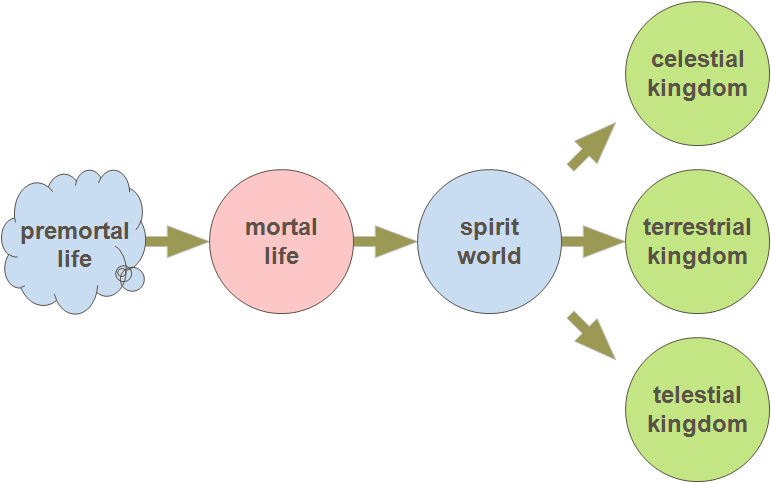
A few weeks ago in church, Sister Johns taught her first relief society lesson on how to be a better leader and example within the church. As soon as the lesson started, she drew three circles on the white board, labeling each of them: premortal life, earth life, and then the spirit life. She turned to us and began to explain a little bit about the plan of salvation The lesson I learned from her is one I will never forget.
from http://www.ldsphilosopher.com/blog_posts/two-views-of-the-plan-of-salvation/
Sister Johns turned to everyone and asked "Why are we here? What is our life-long goal?" Hesitantly, a young relief society member suggested that our entire purpose for being here on Earth is to return to the presence of Heavenly Father. Sister Johns nodded her head, and then explained that by keeping that as our entire focus for everything we do, it will be much easier to know what is right versus wrong. She then tied it back to our lesson and stated that no matter what we do, if we are leaders and examples that point down the path that leads to the Celestial Kingdom, that we are the kind of leaders and examples that we should be. 
I thought that her choice method of delivering this simple, yet profound message of the Plan of Salvation amazing. She had covered so much in so little time. The most intriguing part of what she taught that day was not only the importance of being a leader, but more of the importance of looking at how every decision leads us toward the Celestial Kingdom.

Monday, November 23, 2015

#11: Personal Narrative

Lindsey Tanner
Writing 150
Like Father, Like Daughter
How can I be wrong again? Glancing at the clock I see the bright red numbers reading 6:00. An hour in and I haven’t finished a single problem. At least dad is home, he’ll know what to do. I grab my worksheet and rush into his office. I walk into the dim room, and see the only light in the room being emitted from the computer screens. Dad, sitting at his comfortable black chair hunches over the keyboard which seems to barely fit under his hands. He peers at the monitors as a rhythmic ticking comes from his fingers crawling across the keys. The jumble of letters, numbers, and symbols he had conjured up on the screen intrigues me, so I stand behind him. I brush my hand on his rough blue collared shirt. “What’s that?”
            “Oh, nothing,” he says heavily, almost sighing. His hand slowly reaches up to his eyes, which he rubs, “just a little programming for work.” My head slowly bobs up and down. I understand as much of the mashed up letters and numbers as I do my worksheet. Dad’s eyes descend with his hand and stop, resting on the slightly crumpled paper I am holding. I take a deep breath before asking him for help. Without warning, he springs from his chair which flies across the floor toward the wall. The worksheet is gone from my hand before I knew he had ever reached out to grab it. I stand in silence as his bright blue eyes move across the algebra problems that lie amongst pencil marks, eraser smudges, and torn edges. The corners of his mouth slowly turn up into a smile, and a mischievous spark rests in his eyes. “Do you have any scratch paper?”
            “No, but there is enough space on the worksheet.”
            “Go get a new piece,” he demands. I don’t move. I don’t want to get another piece. I don’t even need it. I can tell by the cool gaze he gives me that he is serious, so I take fresh sheet out of the printer, flip the light on, and join my dad at the crayon covered counter. I stare at the first problem: Jennifer slept for nine hours, how many seconds did she sleep? Slowly, I carve “9 hours” onto my no longer white worksheet.
            “Now, what unit of time is smaller than an hour?” I hear his patient voice say, tinted with excitement.
            “Um, a minute?” I say, almost more of a question than an answer. He nods, and asks me how to turn an hour into minutes. My brows furrow and I tap my pencil on the hard table. You can’t turn hours into minutes. Maybe asking dad was a bad idea. “I don’t know,” I reply. I see a fire ignite in my dad’s eyes. Voice brimming with excitement, he beams, almost shouting.
            “You multiply by one!”
            Bewildered, I can feel my eyes grow so big I’m sure they’ll fall out of my head. Asking dad was a mistake, he has no idea what he’s talking about. Multiply by one? “You can’t do that dad,” I say, a little harsher than intended. “If you multiply anything by one, it will be the exact same number as it was before: nine hours.” I point my finger to the space on the page I had written the number. I hear his voice repeat the instruction. My hand begins to quiver as I feel the confusion overwhelm me. Dad lets out a small chuckle and I am certain he is doubting my intelligence. The apparent amusement he is gaining from my obvious struggle stings, and I can feel my face become hot.
            “How many minutes are in an hour,” he asked slowly, a hint of hope in his voice.
            “Sixty,” I say, trying to keep my voice from shaking.
            “So, sixty minutes and one hour are the same thing, right?” he says. I nod as he continues, “So if you put sixty minutes over one hour, then that’s the same thing as one.”
            “It is not the same thing as one. Sixty is way bigger,” I say, trying to shoot daggers at him with my eyes. This made more sense when I was doing it on my own.
            “Just use the scratch paper. If you write out every step, it will make more sense.” I stare in disgust at the piece of paper he pushes toward me. The tension in his voice is tangible and I feel chills run up my spine. “If you aren’t willing to take my advice, then I’m not going to help you,” he states roughly.
            I hear Natalie, my ten year old sister enter the room. Great. She stands silently at the door watching us for a few moments before I whip around. The command for her to leave slips sharply out of my mouth before I have time to think. She’s just here to make fun of me.
            Suddenly, my body takes over. My hands start shaking and I try to push back the tears brimming in my eyes. How am I supposed to have this done by tomorrow? Against my will, the problems on the worksheet become blurry, and I can feel the hot tears cascading down my cheeks. This father daughter math session has ended just like all the others. I doubt next week’s will be any better.
            The front door slams as sixteen year old Natalie bursts through, letting the chilly fall air run into the house. She’s just barely returned and I can already feel the frustration she has bottled up inside of her. She immediately pulls a large blue geometry book out of her tattered school bag. Loose papers come with the book and flutter chaotically toward the hardwood floor. My dad glances up from the sink as he continues to scrub the grime off of a plate.
            “Geometry homework again?” he questions.
            “I hate it. It doesn’t make any sense and my teacher doesn’t explain anything in class. He expects us to learn everything on our own!” Natalie snaps.
            “Would you like some help?”
            She returns his question with a cool stare. She stands tall and prideful, unwilling to admit that she can’t do the homework on her own. Her blue eyes glare at him through her large black framed glasses. I continue watching the scene from the couch. I remember when my dad would always help me with my math homework, but it had been years since.
            Suddenly he spots me. “I don’t have much time tonight, but Lindsey is really good at math. She can help you.”
            “Fine.” Natalie retorts defiantly. She slams her book down on the table, finds her worksheet, and fumbles for a pencil. I rush over and sit by her side, my eyes move across the geometry problems that lie amongst pencil marks, eraser smudges, and torn edges. She had been working on this earlier.
            “Alright,” I say with a slight smile, “Do you have a piece of scratch paper?”

            My dad looks up at us from the kitchen sink with a smile.

Friday, November 20, 2015

#10: Thanksgiving Traditions

     Around Thanksgiving, my family and I always make Turkey Cookies. All of my siblings, cousins, aunts, uncles, and grandparents gather around the table filled with candy corn, gumdrops, frosting, and cookies. Whenever I think of Thanksgiving, Turkey Cookies are the sweet spot. Ever since I was young, I have always been able to rely on my family making these cookies, which is why they are so important to me. Traditions help me remember past memories and help me feel close to my family. This year, I am going to make sure that Turkey Cookies are a part of my Thanksgiving. I'm going to share my tradition with my friends, and I will be sure to make Turkey Cookies a part of this Thanksgiving.

#9: Personal Narrative Sneak Peek

I sat down next to her and looked over the page filled with rectangles and triangles. At least geometry isn't too hard. She sat in silence as I asked, if she had a piece of scratch paper. The question received a deadly glare from her and a beaming smile from my father.

Wednesday, November 11, 2015

#8: Personal Narrative -- draft/outline

     My personal narrative is going to be about my dad helping me with math. My dad is a great teacher, and by helping me, he enabled me to help my siblings as we grew older.

Characteristics of my dad: great teacher (helps people understand concepts, not just problems), patient, teases, loves learning, laughs a lot, things in a straight forward way.
Characteristics of me: impatient, stubborn, frustrated (at not understanding), love learning, love teaching, desire to understand concepts.
Characteristics of Natalie: wants immediate results, dislikes math, very artistic, visual learner, impatient, very stubborn.

Story line:
1. My dad helping me with homework
     a. I am frustrated
     b. He is persistent, and patiently helps me understand
     c. Typically everything ends in flames
2. I help my sister with her math
     a. I use the same tactics my dad used on me when I was younger

Wednesday, October 28, 2015

#7: Majors and Minors

     For many new college students, the need to choose a major is constantly looming. They are constantly under pressure that they must choose a major as soon as possible. Through this often hasty decision making, many fail to realize the power held behind selecting a major that is seemingly irrelevant to their desired career. By going against the normal flow -- students majoring in the field of their career path -- students are able to show they are open minded and learn attitudes that are far more important to businesses than a major.
     Majoring in fields that are not directly related to career paths broadens perspective. For example, if a student has chosen a recreational therapy career path, they must be knowledgeable on psychology and various therapeutic techniques. However, by majoring in psychology, they are not displaying their academic diversity to employers. Majoring in psychology may enable them to perform well in the recreational therapy field; however, it does not allow them to bring something new and enhance the company for which they are employed. It shows that the student is close-minded and only knows about areas of that field that are absolutely necessary for them to know about. They do not show initiative by learning about something that may not be directly related to recreational therapy. By choosing a major that is not related to a career, one can discover new techniques to bring to the field. If a student were to major in music education and then go into recreational therapy, they would be able to use many of the organizational techniques involved in music education to enhance their performance in recreational therapy.
     Learning and become experienced in a field outside of a career helps one develop attitudes that can significantly impact a career. Returning to the previous example, music education majors are required to develop very understanding, patient, and flexible attitude. As a music education major, one must be very patient with students who may not accomplish all that the educator would like them to. In order to be patient with these students, the educator must also understand the circumstances in the students' lives and how they are influenced by the things around them. A student may not practice the piano for the required time which can be very frustrating to the teacher, until they learn that the parents of that student are getting divorced which is adding a lot of stress to their life. Lastly, music education helps one develop a very flexible attitude. If a student does not practice, they are not prepared with sufficient material to utilize 45 minutes of instruction time. The professor may have planned on instructing that student on the difficult sections of a piece, or answering questions. However, an unprepared student is unable to fill 45 minutes with questions or sections that require assistance. At the moment that student comes in the door, the teacher must develop an entire proactive lesson on the spot to make  up for their student's lack of preparation.
     These attitudes may not have a direct relationship with a recreational therapy career. However, with care, they can be implemented the augment the performance of the therapist. While the techniques on practicing and performance directly related to the piano may not apply in any way to the therapeutic techniques needed, the attitudes are what make the difference. Using the understanding, patient, and flexible attitudes developed in a musical capacity, a therapist is able to be more understanding, patient, and flexible with the problems, needs, and therapeutic exercises and activities that are individual to each of their patients.
     Choosing a major is not choosing a life path. It is choosing to expand perspective and enrich performance in a desired career. First year college students do not need to persistently worry about whether they have a major that is related to their future career. Instead, they should choose to major in something that makes them happy. While studying their major, focusing on the core attitudes of that major and broadening their perspective will impact any chosen career.

Wednesday, October 21, 2015

#6: Parental Hobbies in the Lives of Children

In family settings, children often take after their parents. In terms of careers, interests, hobbies, mannerisms, or simply favorite foods. However, not all children take after their parents. Some children grow up to be more like their mother, or more like their father. Some seem to reflect each parent equally. What is it that makes children take after their parents? While there are many different factors that contribute to the effect of parents on children, one large one seems to be birth order. Perhaps the oldest children are more connected to their parents than middle children, and therefore take after their parents more than the middle children do.
This research topic is very interesting to me. In my own family, I am very similar to both my mother and my father while my other siblings do not seem the same way. The hobbies that my parents had in their childhood are the hobbies that I have been involved in my entire life, however my siblings have completely different hobbies.
I am a little bit worried about finding research on this topic because I do not know where to look for my research. I'm not entirely sure how to find research that is specific to my topic because I feel like my topic is very specific. I'm trying to think of several other factors that could contribute to some siblings having hobbies similar to their parents' while other siblings do not. The success of one sibling in one hobby/talent could deter another sibling from trying to excel in that same thing. That could be another factor? I know there are a lot of things that affect hobbies that people gain, but I can't think of very many that are from a family setting.

Wednesday, October 14, 2015

#5: Research Paper -- topic

     In my family, I have been severely affected by my parents' hobbies. My mother played piano throughout her childhood, so when I was younger she made sure that I did the same. I have grown up with the piano, and still play it today. Because the piano was such a large part of my mother's life, she insured that it was a part of mine. My father and his siblings were all a part of the swim team. After discovering a hatred of running, and the lack of coordination I was blessed with, I resorted to swim team as my sport. I never would have joined a swim team if my father hadn't been involved in it during his childhood. He supported me through my seasons and gave me tips and suggestions to improve my stroke. The experiences my parents had in their youth shaped the childhood that I had. However, none of my siblings were affected in the same way as I was. My sisters all took piano lessons for a time, but they all quit and it was never a major focus of their life. None of my siblings have any interest in swim team: Natalie doesn't enjoy sports, Kaylee is a cheerleader, Mallory plays volleyball, and Zach plays soccer. So why am I the product of my parents' childhood, while my siblings are not? Does birth order affect the amount of influence parents have on their children? What makes a parent's hobbies often seep into the lives of their children?

Tuesday, October 6, 2015

#4: General Conference

I was lucky enough to be able to go to general conference this last weekend. The experience of sitting in the conference center was completely different from watching it at home. I was able to pay closer attention to the speakers, and feel the Spirit through the whole meeting. My favorite talk was given by President Uchtdorf in the Saturday morning session. He is one of my favorite church leaders, and I loved hearing and seeing him in real life. One thing that I learned at conference wasn't something that any of the speakers said. I think that a lot of the time, we view church leaders as these God-like beings that are perfect. While they are very in tune with the Spirit and close to God, I was able to see that they are normal people, just like the rest of us. They have to go through trials with health and hardships just like the rest of us and rely on God just as much as everyone else has to. Learning that was very important to me because it helped me realize that no one is perfect and it just takes practice to be able to recognize the Spirit.

Thursday, September 24, 2015

#3: Rhetorical Analysis

Writing a rhetorical analysis is a daunting task. Sophomore year of high school, our teacher hammered us with ethos, pathos, logos, and (it felt like) hundreds of rhetorical strategies and devices. We wrote a timed rhetorical analysis paper almost every week, and talked about them. At first, writing these were very stressful and difficult, but as time went on, I gained an interest in these strategies and how they were implied to enhance the writer's message. Seeing how rhetorical strategies are used to influence how an audience views a subject is fascinating. Rhetorical strategies are necessary to successfully being able to prove your argument, and by analyzing great speakers, it's a great way to learn about what strategies can be used and how to use them.

Wednesday, September 16, 2015

#2: Mindful Writing -- Being mindful of your Audience

Mindful Writing
    Mindful Writing, written by Brian Jackson, is an intriguing book that teaches its readers how to write. Oftentimes I find reading about writing a chore; however, in his book, Jackson introduces writing in an interesting manner. Throughout its pages, Jackson constantly emphasizes the importance of truly understanding who your audience is. I have read several other books on how to write well, and none of them conveyed this message as strongly as Mindful Writing does. 
     Understanding who the audience is directs the path a writer's message will take. If an audience is not understood, then it is hard to convey a message that will influence the way in which they think.This book has helped me realize that before writing, understand the audience, and then shaping your message will come much more easily.

Thursday, September 10, 2015

#1: A Double-Edged Sword

     Phones, computers, ipods, ipads. The American culture seems to be addicted to technology; however, the frequent use of it seems to be cautioned seldom. David A. Bednar, of the Quorum of the 12 Apostles in the Church of Jesus Christ of Latter-Day Saints, spoke on the effects of technology through two speeches: "Things as They Really Are," and "Sweep the Earth as With a Flood." While both of these speeches embody the use of technology, they focus on the two different groups affected by it -- the user, and the bystander.
     In Bednar's first address -- "Things as They Really Are" -- he focuses on how the use of technology can blind the user from seeing reality. Stating that Lucifer wants us to "disconnect gradually and physically from things as they really are," Bednar highlights technology as one of the major ways Lucifer pulls us from reality. A study done by a Ph.D. graduate student from Stanford University concluded that of online gamers, approximately 40% of men, and 53% of women regarded their online friends equal to, or even preferred their online friends to their friends in reality (Bednar, David A. "Things"). This is just one example of the many ways in which technology is replacing real life experiences with virtual ones.
     Years after giving this speech, Bednar revisits the topic of using technology in his address "Sweep the Earth as With a Flood." Rather than speaking of the affect technology has on the user, he speaks of how to combat the common detrimental use of technology by flooding social media sites with positive messages. Bednar states that modern technology and inventions "have enabled and accelerated the work of salvation," and goes on to outline how to keep social media posts positive by making them authentic and consistent, using edifying and uplifting messages, respecting intellectual property, and being wise and vigilant (Bednar, David A. "Flood"). While in his first address, Bednar focuses solely on the positive and negative effects of technology on the life of the user, he broadens the view through his second speech by envisioning how social media posts by one person have a significant impact on all who see them.
     Technology is a major part of today's society and can be used for many things, good or bad. Technology is a double-edged sword affecting those who use it, and the internet bystanders receiving the messages.

Bednar, David A. "Flood the Earth Through Social Media." The Church of Jesus Christ of Latter-      Day. Provo. Aug. 2015. Web. 2 Sept. 2015. <https://www.lds.org/liahona/2015/08/youth/flood-the-  earth-through-social-media?lang=eng>.
Bednar, David A. "Things as They Really Are." The Church of Jesus Christ of Latter-Day. Provo.  June 2010. Web. 1 Sept. 2015. <https://www.lds.org/ensign/2010/06/things-as-they-really-are?  lang=eng>.